


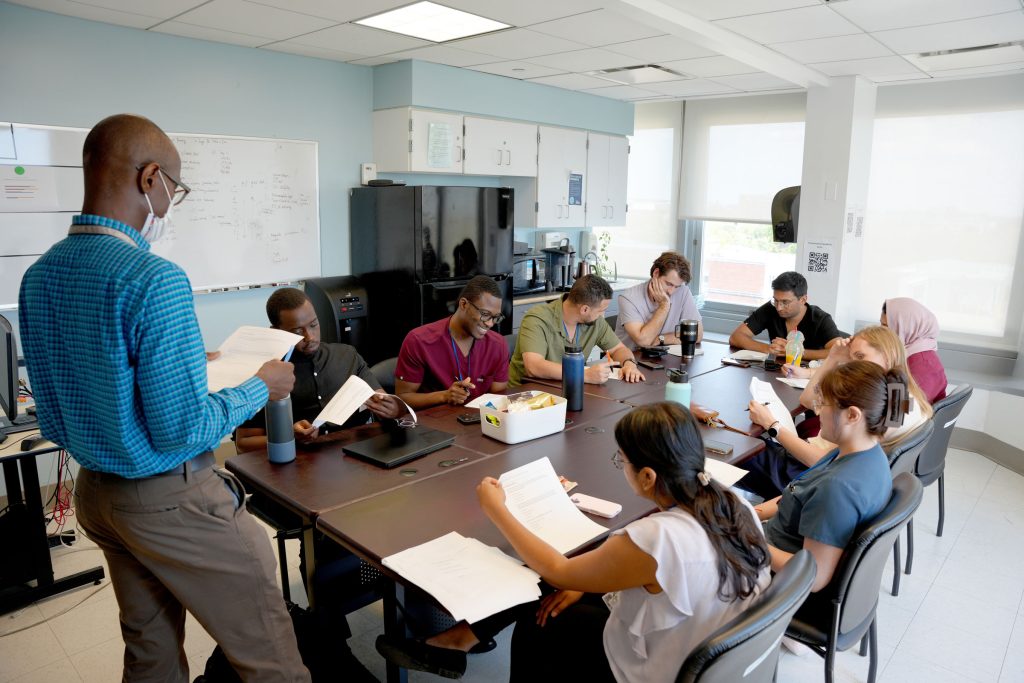
The resident primary care practice is situated at NYC Health + Hospitals/Kings County, a safety-net institution in Central Brooklyn dedicated to caring for underserved communities. You will learn state-of-the-art comprehensive primary care and hospital medicine while caring for a diverse urban patient population. Our curriculum features two half-day sessions of protected learning each week during your two-week outpatient blocks (33% of residency training).
Morning Report
- A practical, case-based session led by residents / faculty
- Presenters utilize different teaching strategies to maximize learner engagement
- Feedback is provided after each session
- This provides another opportunity to develop and practice teaching skills, such as group facilitation and clinical microskills
Core Topics in Internal Medicine
- Three-year longitudinal curriculum covering the ABIM Blueprint. Educational resources include ACP Board Review, Hopkins PEAC Ambulatory Care Modules, and MKSAP questions.
- Part of our “Teaching to Teach” curriculum, with sessions modeled by faculty and taught by residents
- Faculty Coaching and feedback are provided for each session
Doctoring Skills Practicum
- Motivational Interviewing
- Shared Decision-Making
- Managing Conflict
- Teaching Skills for Clinical Care and Group Presentations
- Physical Examination Skills
Primary Care Ambulatory Curriculum
- Evidence-based approach guiding clinical practice
- Yale Office-Based Medicine Curriculum clinical scenarios
Psychosocial Rounds
- Resident forum to discuss challenges, including difficult interactions and situations involving patients, peers, supervisors, and staff
- Trained faculty facilitate each session using a debriefing and reflection model to guide and support peer problem-solving
Quality Improvement & Scholarly Work in Medicine
- Learn quality improvement (QI) processes
- Apply QI tools to real-life situations
- Design, implement, and publish a QI project
- Write an abstract and develop a poster for presentation at professional conferences
Leadership & Career Development
- Writing a winning CV
- Crafting a personal statement
- Navigating the job search and negotiation process
Population Health & Telemedicine
- Dedicated weekly administrative time
- Review chronic disease primary care population panels
- Identify ways to engage and re-engage patients in care
- Connect with patients and faculty to enhance communication around abnormal clinical results
Evidence-Based Practice Journal Club
- Discussion of landmark articles in internal medicine.
- Explore the evidence behind why we practice the way we do
- Critically appraise the evidence, and its application to our clinical practice
Mini-Clinical Evaluation Exercise
- Direct observation assessment of a trainee-patient interaction by faculty.
- Trainees set goals with their preceptors prior to the session and receive timely, specific feedback.
Simulation Lab
- Mannequin-based simulation designed to recreate clinical code scenarios and practice procedural skills.
Point of Care Ultrasound
- Dedicated workshops on the process and application of POCUS in the clinical setting.