


NYC Health + Hospitals/Jacobi | North Central Bronx Stand Up To Violence (SUV) Program Hosts Fordham Leadership Academy Students
Since its establishment in 2014, the SUV program has engaged Bronx youth and worked to connect them to supportive services including educational, vocational, and employment resources
May 05, 2026
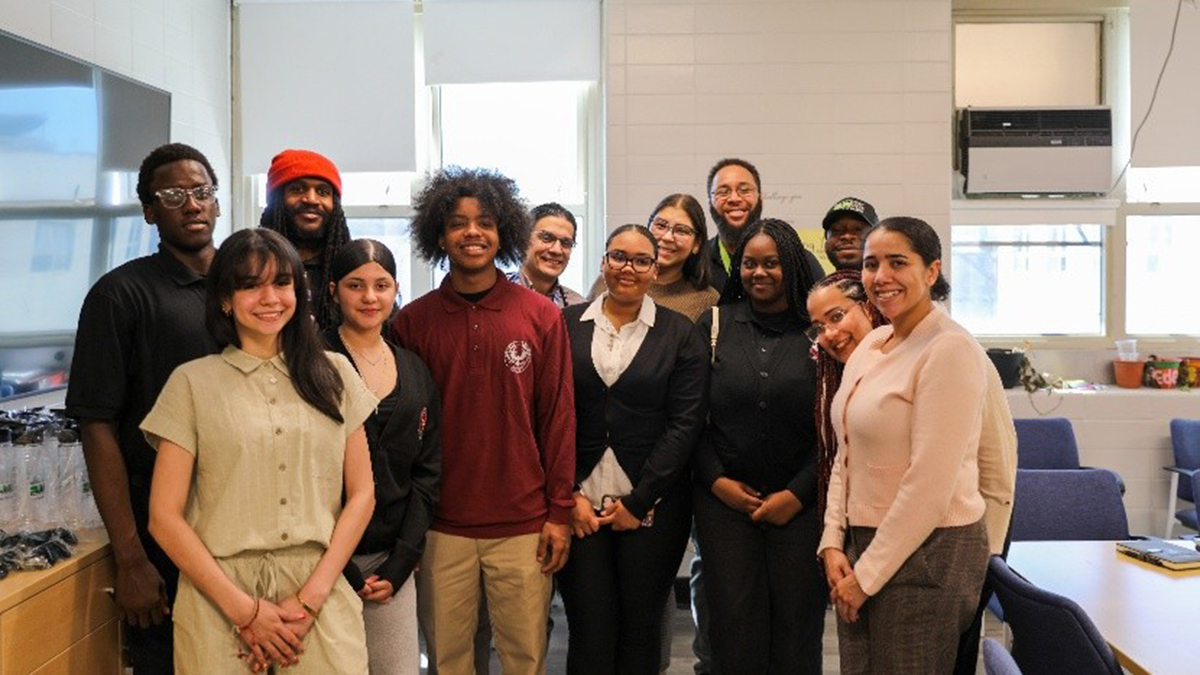
NYC Health + Hospitals/Jacobi | North Central Bronx announced today that its Stand Up to Violence (SUV) program — one of NYC Health + Hospitals’ five Hospital-based Violence Interruption Programs (HVIPs) — hosted students from Fordham Leadership Academy for a tour of its adult Level I and pediatric Level II Trauma Center, where students learned about the care that goes into treating patients of violent trauma. The partnership between Fordham Leadership Academy and the SUV program, now in its second year, has included Career Day, Stand Up to Violence Week, and student hospital tours. Since the SUV program was established in 2014, it has engaged Bronx youth and connected them to supportive services, including educational, vocational, and employment resources. Encouraging young students to consider career goals while offering attainable employment opportunities increases the likelihood of upward mobility. Education and employment services are essential components of SUV’s violence intervention and prevention efforts.
“Exposing students in our community to STEM and medical fields is critical to helping them see careers in these sectors as a viable option for their futures,” said Dr. Noé Romo, Medical Director for SUV and Pediatric Hospital Medicine at NYC Health + Hospitals/Jacobi. “Investment in our youth must include planting a seed of inquiry that can be nurtured to blossom in a way that inspires them to serve their communities on their career paths.”
NYC Health + Hospitals’ HVIP programs — currently established at Harlem, Jacobi, Kings County, Lincoln, and Woodhull hospitals — operate on the principle that violence should be treated like any other communicable disease. Through a three-pronged approach of interruption, prevention, and community engagement, HVIPs seek to break cycles of violent trauma and provide victims and their communities the support they need for a lasting recovery. Collectively, the system’s five HVIP hospitals treat over 3,500 patients for violent trauma each year, with approximately two thirds receiving HVIP interruption, prevention, and community services. The programs’ impact is measurable: a 2023 peer-reviewed study found that patients with violent trauma seen by the SUV team at Jacobi were more than twice as likely to attend over half their scheduled follow-up visits and 59% less likely to return with a re-injury within three months of discharge — and the Bronx community served by SUV has seen a 54% decline in gunshot wound incidence over the past nine years.
Dr. Romo helped establish the SUV program after recognizing, during his work as a Pediatric Hospitalist, how strongly community violence shapes outcomes for pediatric trauma patients. He helped implement a public health approach to hospital-based violence intervention and prevention, working with a multi-disciplinary team spanning social work, surgery, emergency medicine, pediatrics, and senior hospital leadership. Today, the SUV team combines community and hospital violence intervention, utilizing social workers, physicians, community outreach workers, supervisors, and hospital responders to improve both individual patient and community outcomes. The program continuously evolves through evidence-based practice—including its expansion into local schools like Fordham Leadership Academy.
The visit began with students meeting hospital staff from pediatrics, social work, and community health, who shared what drew them to violence intervention work. Students discussed career aspirations spanning business, law, medicine, real estate, and public service. One student expressed a desire to become a detective, another to work with children. Though their paths differed, a common thread emerged: students stay engaged with SUV largely because of the relationships they have formed with program staff, particularly their SUV School Liaison, Daniel, whom they described as a trusted and consistent presence in their lives.

SUV staff described the program as an opportunity to use community trust — hard-earned and deeply valued — to connect neighbors to care and resources. That trust runs through all of SUV’s work, from community outreach to hospital-based violence intervention, where it helps patients feel safe and supported during some of the most difficult moments of their lives.
“When young people are supported in re-engaging with school and accessing employment opportunities, they are better positioned to make positive life choices and envision a future beyond violence,” said Stand Up to Violence Assistant Program Director, Jennifer Montalvo. “This work is strengthened through credible messengers, mentorship, consistent support, and relationships that help young people stay engaged and motivated over time.”
As the mother of two boys, Montalvo has witnessed how easily young people can find themselves in the wrong place at the wrong time, and the jeopardy of their ending up hospitalized or losing their life. She joined SUV as an opportunity to make a difference for her own children and for the broader community. Montalvo has led the program’s incorporation of anti-bullying, anger management, and conflict mediation workshops into its prevention efforts.
In addition to prevention, SUV conducts intervention through a public health lens that addresses root factors affecting victims of violent trauma. Outreach workers — known as “interrupters” —canvass high-risk areas with a consistent, trusted presence, reaching those most likely to engage in violence-related behaviors and connecting them with available services. Social workers then link youth with mental health resources and concrete supports including food assistance and employment services. SUV’s community intervention also focuses on preventing retaliation and mediating conflicts that can span years, with staff meeting regularly with community members to build consistency and transform relationships. When patients are victimized, hospital responders and outreach workers collaborate closely to prevent re-injury and retaliation—a seamless integration of hospital and community response.
After those conversations, students toured the Level I Trauma Center with Jacobi Hospital’s Assistant Director of Operations for the Emergency Department, Desiree Guzman, who walked the class through the emergency response involved in treating patients of violent trauma. Students asked sharp questions, and the discussions that followed helped bridge the gap between classroom learning and real-world health care careers.
Student responses from the visit reflected how meaningful the experience was:
“I first got involved with SUV through a mentorship program at school where Daniel teaches us about our rights and statistics about the community, which allows us the space to explore career opportunities, advocacy, and more,” said a Junior at Fordham Leadership Academy. “We visited the trauma bay at Jacobi Hospital and saw where patients, who are often victims of community violence, are treated. It was eye opening to hear about all of the ways SUV can help our community.”
“Touring Jacobi Hospital with SUV was very fun, new, and informative,” said Melanie, a Junior at Fordham Leadership Academy. “When I asked Desiree about the most impactful case she’s experienced at Jacobi, she shared a story about a 16-year-old boy surviving a violent trauma to the head. It opened my eyes to how fast doctors work, with so many tools, on complex cases. Because of that great and fast work, today that boy is still living life. Being a part of SUV’s mentorship program with Daniel has helped me to see the best in people and I’ve learned ways to motivate others for the better.”
Educational exposure and career pathways help youth develop structure, confidence, and a sense of direction, while employment provides practical skills and responsibility. Together, addressing educational and employment gaps helps optimize youth trajectory by combating community hopelessness, instability, and disconnection.
For more information on NYC Health + Hospitals/Jacobi, please contact (718) 918-5000.
###
MEDIA CONTACT: Catherine Diaz, NYC Health + Hospitals/Jacobi | North Central Bronx, 718-918-4879
#098-26
About NYC Health + Hospitals/Jacobi
NYC Health + Hospitals/Jacobi is a 457-bed teaching hospital affiliated with the Albert Einstein College of Medicine. The facility has earned numerous Center of Excellence designations, accreditation, and recognition for its renowned Level 1 Trauma Center, Burn Center, Surgical Intensive Care Unit, regional Stroke Center, Snakebite Treatment Center, Breast Health Center, Bariatric Surgery Center, and Cancer Service. The facility also offers the region’s only multi-person hyperbaric chamber, allowing up to nine patients to dive together at one time. Jacobi Hospital’s Ambulatory Care Pavilion is a stunning complement to its inpatient acute care, allowing staff to provide patients with high-quality service in a modern, state-of-the-art environment. For more information, visit www.nychealthandhospitals.org/jacobi.
About NYC Health + Hospitals/North Central Bronx
NYC Health + Hospitals/North Central Bronx is a member facility of the NYC Health + Hospitals system, one of eleven acute care facilities within the City of New York. A 215-bed community hospital, North Central Bronx Hospital specializes in women’s and children’s services. It also provides Behavioral Health acute and ambulatory care. Its busy outpatient department has led the way in community-based care delivered in a compassionate and culturally-appropriate manner. Its Labor and Delivery service safely brings more than 1,000 babies into the world each year. North Central Bronx Hospital is committed to providing safe, high-quality medical care for any and all in need. For more information, visit www.nychealthandhospitals.org/north-central-bronx.
About NYC Health + Hospitals
NYC Health + Hospitals is the largest municipal health care system in the nation serving more than a million New Yorkers annually in more than 70 patient care locations across the city’s five boroughs. A robust network of outpatient, neighborhood-based primary and specialty care centers anchors care coordination with the system’s trauma centers, nursing homes, post-acute care centers, home care agency, and MetroPlusHealth—all supported by 11 essential hospitals. Its diverse workforce of more than 46,000 employees is uniquely focused on empowering New Yorkers, without exception, to live the healthiest life possible. For more information, visit www.nychealthandhospitals.org and stay connected on Facebook, Twitter, Instagram and LinkedIn.